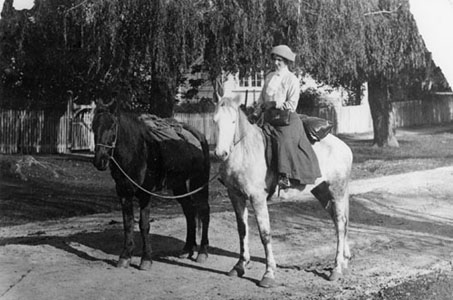
Harsant, Florence Marie 1891 - 1994
Temperance worker, nurse, community leader, writer
Florence Marie Woodhead was born on 19 September 1891 at New Plymouth,
New Zealand, the second of six children of Catherine Davy and her
husband, Ambler Woodhead, a teacher. In 1905 the family moved to
Waitahanui, a Maori settlement on the shore of Lake Taupo, where
Ambler Woodhead became the head teacher at the new native school.
While her parents and older sister taught in the school, Florence
looked after the home. The Woodheads were accepted by the Waitahanui
community, attending tangihanga, weddings and Christmas dinner at
the pa, but Ambler instructed his children not to learn Maori so
that his pupils would be more eager to learn English. However, Florence
learnt the language in her daily dealings with the women of the village.
At 16 Florence Woodhead left home for Whakarewarewa, near Rotorua,
where she was invited to train at the Anglican mission. There she
learnt basic nursing skills; indeed, almost as soon as she arrived
she was required to tend the victims of a typhoid epidemic. In
1911 Florence's mother became ill and she was called home
to nurse her.
Soon after, Ambler transferred to another native school at Tanoa,
on the Kaipara Harbour. Florence worked at a drapery in Hunterville
for a short time, then rejoined her family and taught at the school.
She did not enjoy the work. When in 1913 Eruera Te Tuhi suggested
she become the national Maori membership organiser for the Women's
Christian Temperance Union of New Zealand, she seized the opportunity.
Florence Woodhead received training in marae etiquette from Niurangi
Puriri, a great temperance supporter and the mother of Hone Heke,
MHR. Over the next two years she travelled through Northland,
the East Coast, the Bay of Plenty, and the Whanganui River
region.
Her aim was to establish and foster WCTU branches and to give
advice in hygiene and childcare. With government support
Woodhead wrote
and printed leaflets in Maori on these subjects for distribution
by the Maori groups. She encouraged the women to take control
collectively of their marae, banning alcohol, but at times
they were 'afraid
to
go against their men'. She also encountered opposition from her
own relations, who did not approve of 'all this travelling around
with
the Maoris'.
Florence Woodhead usually travelled on horseback, accompanied
by a local guide. The tracks in remote areas were often rough
and
the horses she was loaned for her trips sometimes unreliable.
Her first
journey, made in the winter of 1913, was to the Bay of Islands.
In the remote Whananaki region she found herself in the midst
of a smallpox
epidemic. Once she had been in contact with victims she was
not allowed to travel back through unaffected villages, and,
terrified
of contracting
the disease, she was eventually compelled to use subterfuge
to escape. On her arrival in Whangarei she alerted hospital
authorities
to the
desperate need for help in the outlying villages and medical
staff and supplies were dispatched immediately.
The damaging impact of alcohol abuse in Maori families motivated
Woodhead in her work, but she also had a sincere affection
for Maori and their culture, rare among Pakeha. Her respect
for Maori
mores
and spirituality, including belief in the power of tapu,
helped win her acceptance. She had a strong religious faith
but was
non-denominational and flexible in her approach to her mission.
Florence Woodhead's work for the WCTU was halted in 1915
by a bungled appendectomy, which left her an invalid for
some
time.
She returned
home to Tanoa, where she continued her work with the local
WCTU and taught in the school. She also nursed Maori during
the 1918
influenza
epidemic.
On 4 February 1919 at Whitianga Florence Woodhead married
Horace Henry Harsant, a farmer from Hahei, on the Coromandel
Peninsula.
They had met when Florence and her younger sister were
holidaying with his family. She soon realised that her life
as a farmer's
wife would be very different from her holiday experience.
Horace and his
brother ran the farm jointly, and Florence found her brother-in-law's
tight control of all the finances difficult to accept.
For many years Hahei remained isolated, and Florence's first
baby died
at birth
because she was unable to reach medical help. She missed
her Maori friends and her family and was often lonely.
In
time
she found
new occupations. She set up an aided school, teaching her
own children and nephews who boarded with her. During the
Second
World War she
lived at Matata, Bay of Plenty, where she ran the post
office. On
her return to Hahei after the war she and her son Vaughan
established a public library in her home under the auspices
of the Country
Library Service.
After her marriage Florence Harsant wrote short stories
for such publications as the New Zealand Dairy Exporter
and Straight
Furrow
with the pen-names 'Quick Silver', 'Trouser Button' and
'Virgo'. Her primary aim was to make money for herself
and her children,
but she developed a strong interest in writing. She took
a correspondence course in short-story writing in 1946.
In her
83rd year she bought
a typewriter and taught herself to type. She recorded
the story of
her life, which was published in 1979 as They called
me Te Maari.
Following Horace Harsant's death in 1974, Florence renewed
her links with the people of Waitahanui and in 1975 memories
of her
childhood
there and journeys for the WCTU were recorded for two
radio documentaries. In spite of failing eyesight and hearing
she remained vitally
interested in people and the world, maintaining a wide
circle of correspondents,
for whom she was a living link with New Zealand's past.
She was awarded a Queen's Service Medal when aged 90,
in
recognition
of her community
work.
Florence Harsant died at Thames Hospital on 19 June 1994,
aged 102, survived by her three sons and two daughters.
In acknowledgment
of
her bicultural life she was given both a Pakeha service
and a tangihanga at Matai Whetu marae near Thames.


